

When I started The Skilled Project, the goal was to bring more people into the skilled trades. Rebrand them. Change the narrative. It was a marketing problem, right? We had stigmatized and de-invested in these careers for decades.
And I mean, when you think shortage, what’s the first thing that comes to mind? We’re short something. We don’t have enough of something. So we just need more people became the rational explanation.
But as I kept preaching that we need more people, I kept having these deja vu conversations. People in the field saying, “That’s great and all, but tell me how you’re going to keep people?” People on social media reaching out saying they couldn’t find an apprenticeship, or they’d been on years-long union waitlists, or people in residential construction saying no one would hire them without “3-5 years experience.” A few women I interviewed described being harassed out of the industry.
And then one morning in the fall of 2025, I was dropping my daughter off at school and thought I saw Big Nate behind the wheel of a truck at a stop sign. How could that be? Nathan Shannon, my dear friend, my high school prom date, had died by overdose in 2020 right after passing his Journeyman’s Millwright exam in San Diego, California.

It had me sitting there wiggling, knowing deep down that something was off. What this AI boom is quickly exposing, which in my body I was feeling, is that recruiting more people into these careers isn’t going to solve the shortage.
Because the “shortage” is not the problem. The shortage is a symptom.
The Demand
I was impacted by the “shortage” when I was previously running a company in the clean energy space. I couldn’t comprehend how we were pushing these energy solutions yet, we didn’t have the skilled workforce developed to actually execute on any of these promises. Compound that with a housing crisis, the fact that the U.S. went about four decades of underinvestment in our infrastructure and it’s all coming due to upgrade, a massive chunk of people are retiring over the next few years, and now enter…the AI race. More than 40% of a nearly $7 trillion global data center build-out is expected to land in the U.S. by 2030 (McKinsey).
Developing this workforce feels like the single biggest hurdle in realizing our future, while simultaneously changing the trajectory of a lot of people’s lives. But here’s where the shortage framing has become quite frankly, problematic. It has collapsed supply and demand into one frame: not enough workers. Which makes the solution sound simple. More people. And it’s sending every state, every foundation, every Fortune 500 Company chasing the same answer. Pour money into recruitment and training.
Last month, The New York Times reported that blue-collar work has plateaued. Manufacturing and construction lost 150,000 jobs over the past year. Hiring is at 2009 recession levels. Economists in the piece called it cyclical – Tariffs, immigration, interest rates, frozen housing. But buried at the end of the same article was this: “In the areas where data centers are being built, they literally can’t find bodies fast enough.” I’ve spoken with enough people constructing data centers to know that this is in fact true.
It seems we’ve built a system that makes us unable to move people to where the work is, in any direction, at any given time. That’s not a cycle. And that’s not a shortage. That’s one dysfunctional system.
A Leaky Bucket and an Even Leakier Pipeline
I’ve spoken with hundreds of tradespeople and construction workers over the last few years, and the data and the stories point to the same conclusion: we are bringing people into the trades, but we’re losing them at every stage. And in many cases, access and mobility is constrained.
My best analogy is that the skilled trades and construction workforce resembles a leaky bucket with an even leakier pipeline – poorly designed and clogged in critical places.

Here are a few of the realities:
In many regions across the U.S., union apprenticeships are full and some have waitlists in the thousands
Apprenticeship program dropout rates run between 40% and 65%, depending on which study you read. Even the low end is staggering.
Construction workers are 5x more likely to die by suicide than a jobsite accident, and the industry as a whole lost about 16,000 people in 2024 to death by suicide and overdose combined.
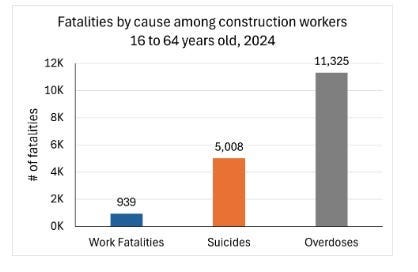
The Center for Construction Research and Training Over 40% of tradeswomen have seriously considered leaving the industry due to discrimination, harassment, and lack of respect, according to one of the largest national surveys conducted on tradeswomen by IWPR in 2021. And in November 2025, a 20-year old female welder – Amber Czech - was murdered in Minnesota by her male coworker. It has caused a deluge of outrage by tradeswomen online reciting work experiences that mirrors the “Me Too” movement.

None of this looks like a shortage. So why do we keep calling it one?
The Reframe
Because focusing on the shortage as the problem lets every actor in the system off the hook. It obscures the dysfunction and shifts the blame to the worker who left versus the system at play. It deflects the need to have to change.
A former Independent Electrical Contractor (IEC) educator in the midwest told me recently: “I never liked the fact that we would brag about how many people we had enrolled, but we didn’t do a good job of keeping them. That bothered me to my core.”
She gave me her list of why her apprentices dropped out. The majority of the reasons were a condition: lack of mentorship, poor onboarding, toxic field culture, mismatch of job expectations, life circumstances with no support system around them, information they should have had upfront and didn’t.
Unfortunately, underneath this shortage narrative is an enormous amount of waste hiding in plain sight. Of dollars. Of potential. Of lives lost.
As Josh Vitale, a Senior Superintendant and Co-founder of Project BUILT – a nonprofit focused on addressing the suicide and overdose epidemic in the trades – put it: “We’ve been building for extraction, not for longevity.”
Until we reframe that the shortage is a symptom of a bigger systems problem, we’ll keep pouring more water into the top of this bucket wishing, hoping, waiting, to get different results.
Now What?
Getting more people exposed to these careers matters. It’s some of the work I’m involved in. But you can’t recruit your way out of a system that loses people at every stage.
The beauty of reframing the problem though, is that the underlying questions start to change. Who built this and why? Who benefits from it staying the way it is? What would it take to design something that actually works for the people doing the job? And underneath all of them: what are the financial implications? The real needle mover.
If half of apprentices never finish, what is that costing?
If workers leave because of preventable culture and leadership failures, what does that cost?
If taxpayer dollars fund workforce initiatives that fail to keep people in the industry, what are we actually funding?
Over the coming weeks I’ll be answering those questions, sharing what’s failing across the system, and connecting it to potential solutions.
Because the people building America deserve better.
RIP Big Nate.
Thanks for sharing, Amanda. Looking forward to what's to come!
A good read this Saturday morning, Amanda.
As one who has many, many of these conversations, and grew up as a skilled craft laborer and operated a commercial mechanical & technology systems contracting company I have known this industry from toddler to today.
The root of the problem lies in the industry's complete lack to truly engage the skilled laborer in a humanistic manner.
My life's work has been distilled into this solution.
Happy to chat with anyone who strives to truly work on this.
Brett
brett (at) builtdata.io